What is data governance and how does it build trust?
Data governance is the set of policies, processes, roles, and standards an organisation uses to manage its data effectively.
Organisations do not need to govern every dataset in exactly the same way. A practical approach usually begins by identifying the data that is most important or most sensitive.
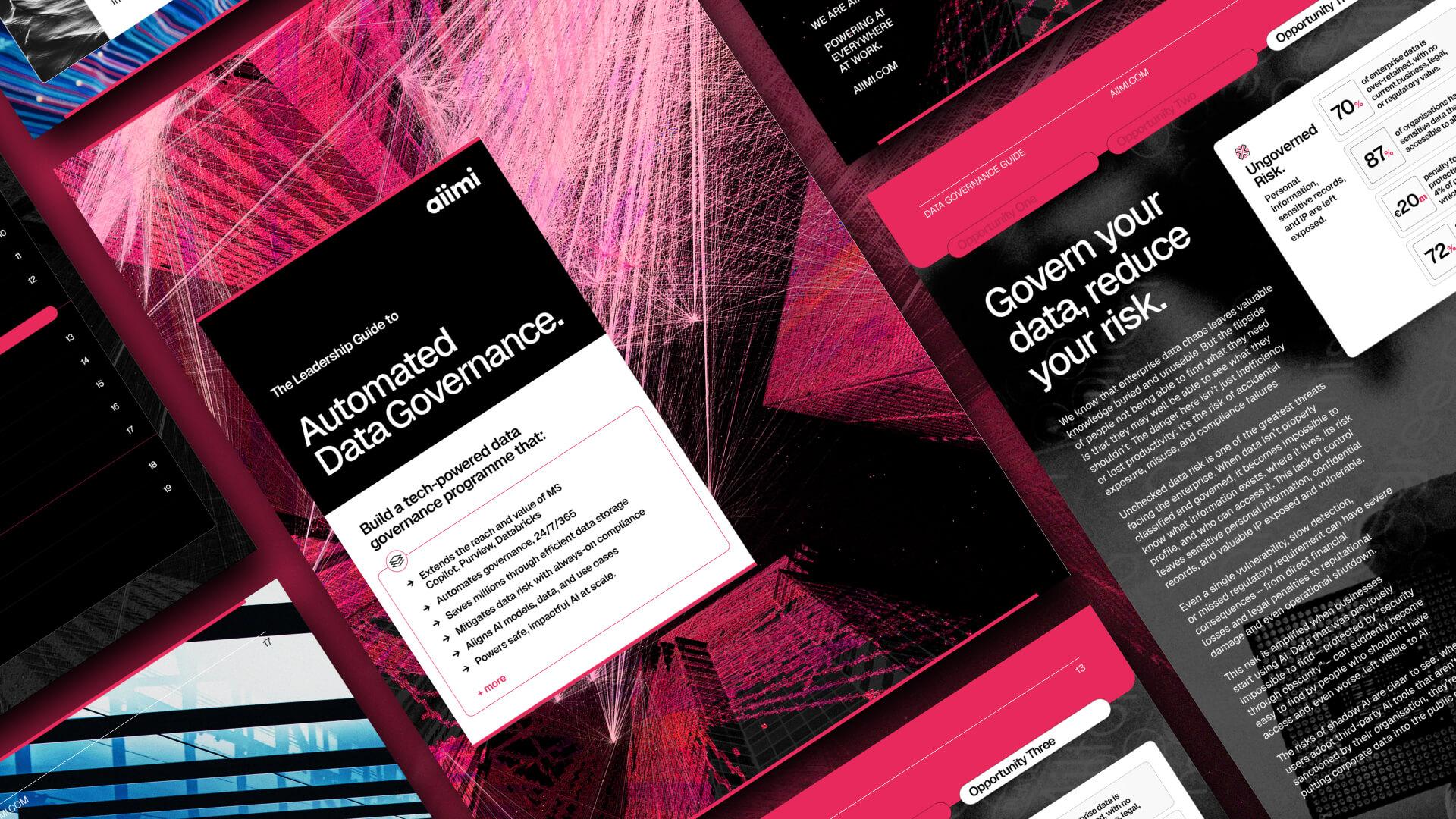
Aiimi's data governance tools ensure valuable data is made usable for your teams and AI tools, and sensitive data is kept safe.
Using AI and ML automation, our platform rapidly classifies and manages data, 24/7/365, without needing to move anything.
Data is one of the most valuable assets in an enterprise. Organisations use it to understand customers, improve operations, manage risk, develop products, and make better decisions. But data is only useful when people can trust it, access it appropriately, and understand what it means.
This is where data governance comes in. It is the set of policies, processes, roles, and standards used to manage data effectively – establishing who is responsible for data, how it should be handled, who can access it, and how its quality and security are maintained throughout its life.
Traditionally, governance has been a largely manual discipline: committees, spreadsheets, glossaries, and periodic audits. This approach worked when data was smaller, more structured, and sat in a handful of systems. It doesn't work in the modern enterprise, where data volumes are vast, most of it is unstructured, and it is spread across cloud platforms, legacy systems, collaboration tools, and file shares. To keep up with today’s data estate, governance must be automated.
Why is data governance important?
Without governance, data soon becomes impossible to manage effectively. Different business units store the same information in different systems, use inconsistent definitions, and apply different standards for collecting and protecting it. For example, the Sales team counts a customer as "active" from the moment a contract is signed. Finance counts them once the first invoice is paid. Customer Success only counts accounts where the product is in use. When the Board asks how many active customers the business has, three teams give three different answers, each defensible and none comparable. Time is spent reconciling numbers instead of acting on them, and confidence in reporting erodes.
Beyond this simple example, the wider risks are far greater: sensitive client data sitting in unmanaged locations, contracts and personal data kept long past their retention date, and AI tools drawing on content nobody has reviewed.
Effective governance creates consistency and confidence. Employees know what data means, where it comes from, how reliable it is, and how it should be used.
Good governance helps organisations:
Improve data quality and accuracy
Protect sensitive and confidential information
Reduce duplication, redundant data, and storage costs
Make information easier to find and use
Clarify responsibility for data
Support faster, better-informed decisions
Reduce operational and security risk
Get real value from AI – trusted data inputs mean accurate and trustworthy AI outputs.
What does data governance involve?
Data governance is broader than storing data securely; it covers the whole data lifecycle, from creation and collection through to use, sharing, archiving, and deletion. In practice, six areas matter most.
1. Data ownership and accountability A governance framework defines who is responsible for particular datasets. Those individuals or teams make sure data is accurate, properly managed, and used in line with policy. Roles typically include data owners, data stewards, security and IT teams, and business users.
The challenge at enterprise scale is that ownership can't be assigned to data nobody knows exists. Automated discovery and classification are what make accountability practical, because they show you what data you have and who it should belong to.
2. Data quality High-quality data is accurate, complete, consistent, timely, and fit for purpose. Governance sets the standards for measuring quality, the thresholds that matter, and the processes for finding and resolving errors.
Manual spot checks only cover a sliver of the estate. Automated quality monitoring applies those standards continuously – flagging duplicates, gaps, and inconsistencies as they appear rather than months later in a report.
3. Data security and access Most enterprise data is either too locked down or too exposed: over-restriction stops people getting value from data they should be using, and over-exposure puts sensitive information at risk. Governance determines who can access what, and under which circumstances, through access controls, authentication, encryption, and rules for handling sensitive content.
You can't protect sensitive data you haven't identified. Automated classification finds and labels it, wherever it lives, so that access policies can be applied accurately and kept up to date as content changes.
4. Privacy and compliance Governance gives organisations a structured way to meet their obligations under data-protection and privacy regulation, such as UK GDPR, and industry-specific rules on how data is collected, stored, processed, and shared. Compliance depends on knowing where personal and regulated data is, why you hold it, and how long you're entitled to keep it. Automation transforms this from a periodic audit exercise into an ongoing, evidenced capability.
5. Data standards and definitions A governance programme establishes common definitions, formats, naming conventions, metadata, and classification schemes across the enterprise to make information comparable and remove manual reconciliation effort.
Consistent metadata is what makes data discoverable and trustworthy, for people and for AI. Automated tagging and enrichment apply those standards across the whole estate, rather than relying on every individual to label and save content correctly every time.
6. Data lifecycle management Governance defines how long different types of information should be retained, when to archive it, and when to delete it securely. This controls storage costs, reduces risk, and avoids holding data that has no business or legal reason to exist. Applied manually, retention rules are rarely enforced consistently – automation applies policies as data ages.
Who is responsible for data governance?
Data governance is not solely an IT responsibility. IT teams may implement the technology and security controls, but effective governance also needs engagement from business leaders and the people who create and use data every day.
A typical governance structure includes:
Executive sponsors, who provide strategic direction and backing
Data owners, who are accountable for specific areas of data
Data stewards, who maintain quality and enforce standards
IT and security teams, who provide technical controls and infrastructure
Legal and compliance teams, who advise on regulatory and privacy requirements
Business users, who follow policy and report data issues.
The exact structure varies with the organisation's size, industry, and data requirements. What matters is that the people in these roles are supported and enabled by governance, rather than burdened with it. Where owners and stewards are expected to find, classify, and review data by hand, governance stalls. Automation takes on the repetitive work, so people can focus on the decisions that need human judgement: defining policy, resolving exceptions, and acting on insight.
Data governance vs. data management
The two terms are closely related but not the same. Data management is the practical handling of data: storing, integrating, processing, securing, and maintaining it. Data governance provides the framework that determines how those activities should be carried out. In simple terms, data management is about managing data, while data governance is about setting the rules and responsibilities for managing it.
The two meet in execution; a policy is only as good as its enforcement, and a policy that depends on someone remembering to apply it will fail. Modern governance closes that gap by embedding policy directly into how data is classified, accessed, and retained, so the rules are applied by the system rather than left on paper.
How to build an effective data governance programme
Automation is the only practical way to do data governance today. Data is growing too fast, changing too often, and sitting in too many places for manual processes to keep up. For many organisations, governance is still seen as a laborious, multi-year undertaking.
"At Aiimi, we start by reassuring customers that they don't have to boil the ocean; instead, start small and stay focused. Improve data governance, data classification, and data quality in the areas you need it most." – Steve Salvin, Aiimi CEO & Founder
In our experience, an effective data governance programme tends to follow a clear sequence:
Start with what matters most. Identify the data that is most valuable, most sensitive, or carries the highest risk, such as client contracts, personal data, or the content feeding critical decisions or AI initiatives. Don't try to govern everything at once.
Discover and classify automatically. Use AI and ML to scan, understand, and classify data where it already sits. This is the foundation, because it replaces assumptions about your data with an accurate picture. Aiimi’s platform does this without needing to move or copy data, working across existing systems without disruption.
Establish ownership and standards. With visibility in place, assign owners and stewards, agree common definitions, and set data-quality and classification standards.
Turn policy into automated controls. Apply access, retention, and handling rules automatically based on classification, so they are enforced consistently and continuously. Data stays where it is by default, but where it's in the wrong place, or over- or under-exposed, Aiimi can migrate or remediate it.
Monitor, measure, and expand. Track quality, risk, and coverage, resolve issues as they surface, then extend into the next business area.
Technology supports each step through data catalogues, metadata management, quality monitoring, access management, and automated policy controls. But technology alone doesn't create effective governance; clear responsibilities and genuine organisational commitment matter too. The aim is to combine the two, with people setting direction and automation doing the heavy lifting.
The benefits of good data governance
When governance is implemented well, organisations stop treating data as scattered information and start managing it as a strategic asset.
"The real value in data governance – the kind you can measure and attribute results to – has always been in improving the quality, completeness, and relevance of the data that feeds your most critical decisions." – Steve Salvin, Aiimi CEO & Founder
The practical benefits include:
Less manual effort. Automation takes over the work that otherwise consumes data, IT, and compliance teams: finding, classifying, and tagging data, reviewing access, preparing for audits, and enforcing policies. People spend their time on decisions and exceptions, not upkeep.
Faster access to the right data. Consistent classification and metadata make valuable information easier to find, and make it safe to open up to the people who need it. Governance becomes an enabler as well as a control.
Better decisions. Common definitions and known quality and completeness mean the data behind critical decisions holds up to scrutiny.
Lower risk. Sensitive and regulated data is identified wherever it sits and protected by policy. Compliance becomes something you can evidence on demand rather than unpick at audit time.
Lower cost. Redundant, obsolete, trivial, or duplicate data is identified and removed or archived automatically, cutting storage costs and the effort of managing data with no business value.
AI readiness. Well-classified, high-quality, appropriately controlled data enables AI tools to deliver reliable results without exposing content they shouldn't see.
Perhaps most importantly, good governance creates trust in data and makes it usable.
Impact and conclusion
Data governance is the foundation for the responsible, reliable, and effective use of data. It brings together people, processes, policies, and technology so that data is understood, protected, accessible to the right people, and maintained to an appropriate standard.
As organisations collect and rely on ever more information, governance is no longer just an IT concern – and it can no longer be managed manually. It is central to how enterprises manage risk, operate efficiently, and make informed decisions, and it increasingly determines how well they can use AI.
Aiimi's data governance platform makes data a valuable, strategic asset for people and AI tools. By classifying and managing data automatically, around the clock, and in place, it ensures enterprise data is always trusted, understood, and ready to use.
Talk to us about where to start and find out more about our Automated Data Governance platform.
Stay in the know with updates, articles, and events from Aiimi.
Discover more from Aiimi - we’ll keep you updated with our latest thought leadership, product news, and research reports, direct to your inbox.
You may unsubscribe from these communications at any time. For information about our commitment to protecting your information, please review our Privacy Policy.

Discover our Automated Data Governance platform
Talk to us about where to start and find out more about our Automated Data Governance platform.
Find out more