The missing link in your AI strategy? Unstructured data governance.

We know AI is only as good as the data behind it; low quality, poorly governed data leads to inaccurate and untrustworthy AI outputs – making good data governance a prerequisite for AI success. But most governance programmes were built for structured data, aka the databases, platforms, and systems that are easiest to catalogue, manage, and control.
Whether you apply data ownership models using tools such as Microsoft Purview, Talend, and Informatica, or manage data quality through platforms such as Collibra and Qlik, traditional approaches are largely geared towards structured data sources. Now, the same rigour and discipline must be extended to unstructured information, because AI tools can read, surface, and reason over this content in ways that earlier systems never could.
Traditional data governance has always been about creating the foundations for trusted data through clear ownership, accountability, policies, standards, and operating models. These principles have become even more important in the age of AI – in fact, organisations cannot successfully get value from AI without them.
And yet, our experience with customers shows that some of the biggest barriers to AI adoption rarely sit within structured data platforms. Instead, they lie within the vast stores of unstructured information spread across documents, emails, SharePoint, Teams, file shares, and business content repositories – often the largest but least understood part of the enterprise data estate.
For example, in our AI Accelerator work at Anglian Water, the real value comes from connecting the two sides of its data estate. For solutions created to support the Control Centre during live events, structured operational data provides the signals about what is happening, while unstructured data captures the context, experience, and lessons from previous events. Governing and combining these within AI-Enriched Data Products provides the team with actionable insight, helping them respond to operational incidents faster and more effectively.
Organisations seeking to operationalise AI must be able to answer some fundamental governance questions about their unstructured content: What information do we have? Is it sensitive? Who should have access to it? How long should it be retained? Which information is authoritative and trustworthy? These are classic governance challenges, but they can no longer be solved via traditional governance approaches.
For example, data ownership frameworks typically rely on structured data, with identifiable owners and well-defined boundaries. Trying to apply this approach to a SharePoint document library containing diverse and varied information from across the business would be arduous, complicated, and add little value. The issue is not that traditional governance principles are no longer relevant, but that applying them manually to unstructured information is neither practical nor scalable.
Automation is the only way to apply governance policies consistently across the entire data estate, including unstructured content, at the pace and scale required by AI.
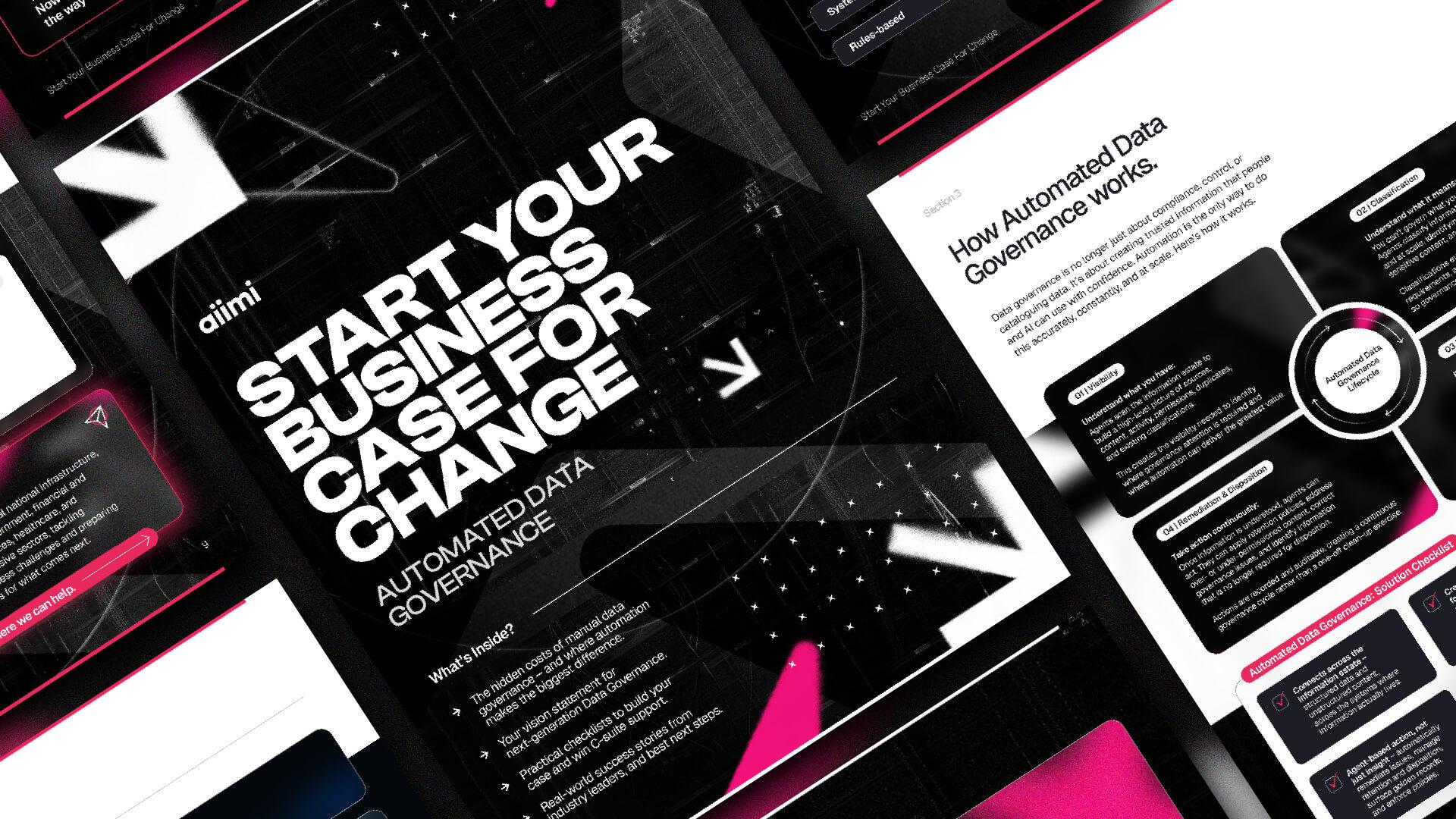
Through capabilities such as classification, labelling, retention, access remediation, and lifecycle management, Automated Data Governance extends governance controls to unstructured data. The result is a governed, trusted, and AI-ready information landscape. Organisations are able to uncover new value from the largest part of their data estate, connecting unstructured information with their structured data ecosystem and enriching it with the context, expertise, and tacit knowledge often buried within documents and content.
This is the missing link in many AI strategies: bringing structured and unstructured data together through effective, scalable governance. Automated Data Governance is what makes that possible.
Find out more about Aiimi's AI Strategy Services and Automated Data Governance platform.
Stay in the know with updates, articles, and events from Aiimi.
Discover more from Aiimi - we’ll keep you updated with our latest thought leadership, product news, and research reports, direct to your inbox.
You may unsubscribe from these communications at any time. For information about our commitment to protecting your information, please review our Privacy Policy.
Get in touch
Want to find out how Aiimi can help your organisation? Get in touch with our team to discuss your needs.
Get in touch